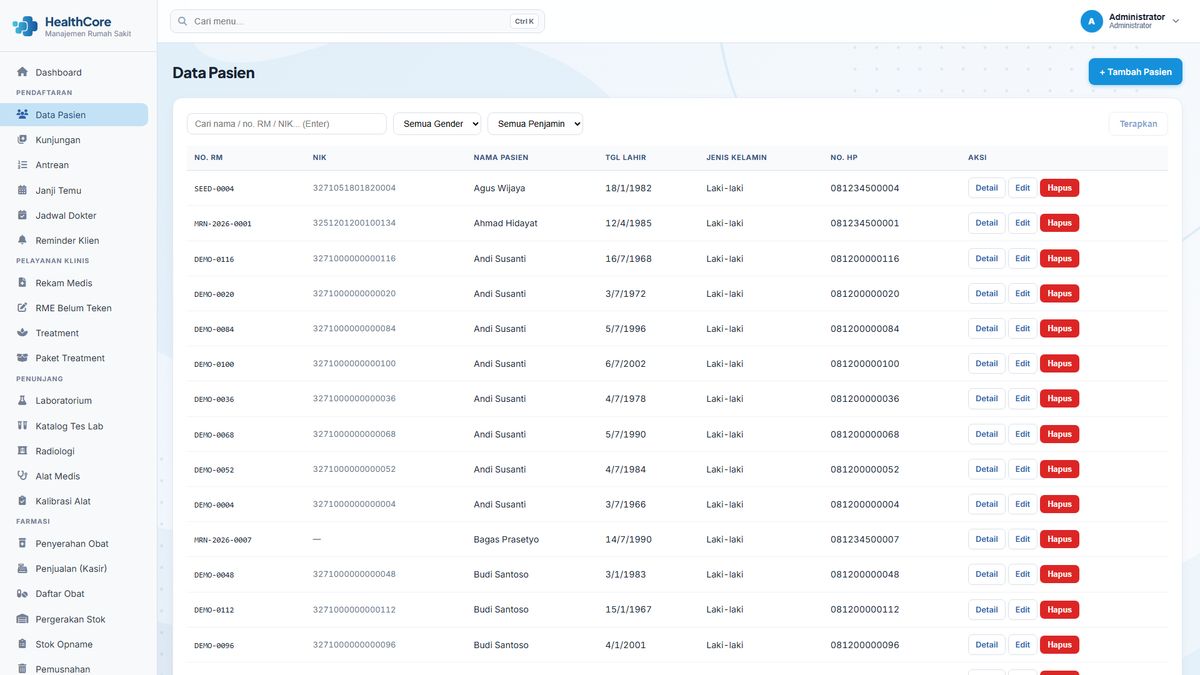
SIMRS Patient Registration Module: Master Data & Medical Record Numbers
Patient Registration is the entry point of the entire operational workflow of a healthcare facility. Everything recorded here (patient identity, medical record number, contacts, and visit history) becomes the foundation other modules rely on, including appointments, queues, electronic medical records, pharmacy, and billing. The module is designed so front office staff can build and maintain patient master data from one structured screen, without working across separate systems.
Complete and consistent patient master data
The module stores patient data in a single master record: name, national ID number (NIK), date of birth, contacts, and address. Every patient receives a unique medical record number (MRN). The number used across modules to ensure a patient’s history always stays attached to the right person, from the first visit onward. Structured data at the start makes patient search, form filling, and billing faster and less error-prone.
Verification and duplicate prevention
One of the most common front office problems is a patient registered twice with slightly different details, splitting their medical history across two records. This module performs patient verification and duplicate prevention: the system checks new entries against existing records (for example matching name and date of birth) so staff can detect an already-registered patient and update the existing record instead of creating a new one. Medical record number and phone validation also keep data quality high from the start. The result is one patient, one history, one medical record number, and one complete visit status.
A consistent registration flow
The arrival flow is designed to stay consistent across every shift: staff search for the patient by name or medical record number, select an existing record or register a new patient, verify identity, then move the patient into the visit flow. For returning patients, data is not retyped. The stored identity is reused and only changed fields are updated. This reduces queue time at the counter and avoids the typing errors common when the front desk is busy.
Connected to billing and the visit flow
Registration data connects directly to other modules. Once a patient is registered, their basic information is ready to be used for initial billing and to move the patient into the visit flow, with no re-entry. This keeps the front desk and cashier from working in separate systems, and every transaction that happens after registration stays linked to the same medical record number.
Who uses this module
The module is used mainly by registration and front office staff, and is a reference for cashiers, nurses, and doctors whenever they need patient identity or a medical record number. Access is controlled by role-based access control (RBAC), so each staff member only sees the data relevant to their work.
One data set, one flow
A key advantage of structured registration is that the same data flows through every module. The medical record number created here is used by appointments when the patient is scheduled, by the cashier when an invoice is created, and by the doctor when the medical record is opened. When patient data changes (for example a phone number or address) the update is done once, and every module reads the updated data. The facility does not need to rebuild patient data in each system or at each visit.
Getting started with this module
The module can start from the facility’s core needs first, then grow in phases. In line with HealthCore’s implementation principles. In the early phase, the facility team and the HealthCore team prepare master data, define the registration flow for new and returning patients, then train front office staff on that flow. Role-based training, go-live support, and data migration are quoted separately from subscription pricing, so the facility starts from the highest-impact area without changing every process at once.