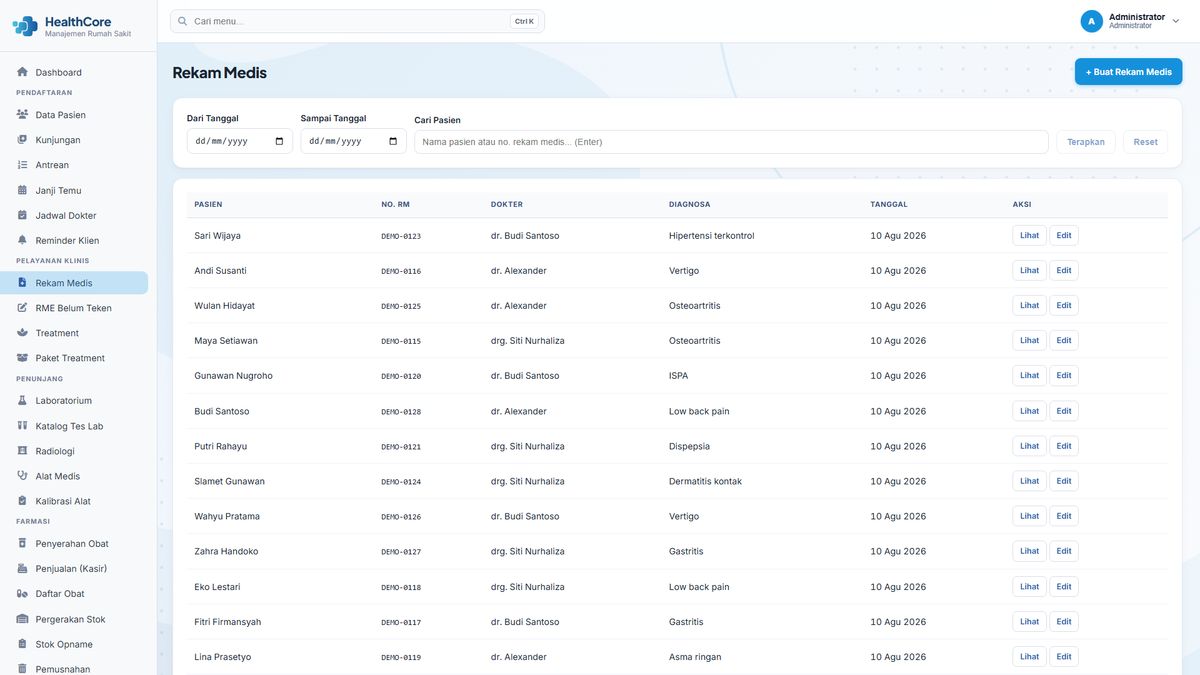
SIMRS Electronic Medical Records (EMR): SOAP, CPPT, and ICD-10
The Electronic Medical Record is the core of the HealthCore clinical workflow. Doctors and nurses work on a patient history that is stored digitally, structured, and easy to retrieve. From anamnesis, examination, diagnosis, procedures, to prescriptions. Instead of opening several files and systems, the clinical team sees the full patient context in one continuous flow.
Structured clinical documentation: SOAP and CPPT
Doctors document examinations in SOAP format (Subjective, Objective, Assessment, Plan) with integrated CPPT progress notes that run as a chronological record. Every entry is recorded in sequence with the author’s identity, so the patient’s progress can be traced over time. Anamnesis and patient vitals are recorded in the same visit context, so the doctor’s assessment always sees the full picture rather than fragments of data.
ICD-10 diagnosis and clinical follow-up
Diagnoses are recorded using ICD-10 and become the basis for clinical follow-up: treatment plans, consultations, supporting examinations, and prescriptions all refer to the same diagnosis. With structured diagnoses, patient data is ready for reporting needs and continuity of care across visits.
Electronic prescriptions connected to pharmacy
Prescriptions written by doctors connect directly to the pharmacy module. This flow removes paper and retyping: electronic prescriptions are forwarded to the pharmacy, medicine stock can be deducted at dispensing, and the patient’s medication history is recorded in the medical record. This connection reduces information-transfer errors between the clinic and pharmacy.
Medical summaries and discharge status
At the end of the service, the doctor prepares a medical summary and sets the patient’s discharge status. Complete with a summary of anamnesis, examination, assessment, and plan. This documentation bridges outpatient care and the next visit, and supports administrative and referral needs.
Documentation depth that supports patient safety
Beyond the SOAP/CPPT core, the EMR includes structured assessments used by nursing teams: pain assessment, nutrition screening, fall risk assessment, and vital signs recorded as a time series. Cross-specialty consultations and supporting examination results (including laboratory results) also appear in the patient’s record, so clinical decisions are not interrupted across units.
Who uses this module
Doctors record diagnoses and prescriptions; nurses complete assessments, procedures, and patient progress; pharmacy staff receive electronic prescriptions; and management uses clinical documentation for accreditation and quality control needs. Access is role-based so clinical notes can only be modified by authorized parties.
One data set, one flow
The EMR is the clinical data center that many parties fill and use. Laboratory results enter the record from the supporting module, prescriptions flow to the pharmacy, and clinical service invoices are built from recorded procedures. A doctor opening a patient’s history sees one sequence: previous visits, diagnoses, supporting results, and medicines ever given. Because clinical notes are stored digitally and connected, continuity of care does not depend on paper files that can be lost or split across clinics.
Getting started with this module
The module can start from the facility’s core needs first, then grow in phases. In line with HealthCore’s implementation principles. In the early phase, the facility team prepares supporting master data (doctors, clinics, documentation patterns), defines the daily examination flow, then trains doctors and nurses on that flow. Role-based training, go-live support, and medical record data migration are quoted separately from subscription pricing, so the facility starts from the highest-impact flow without changing every process at once.