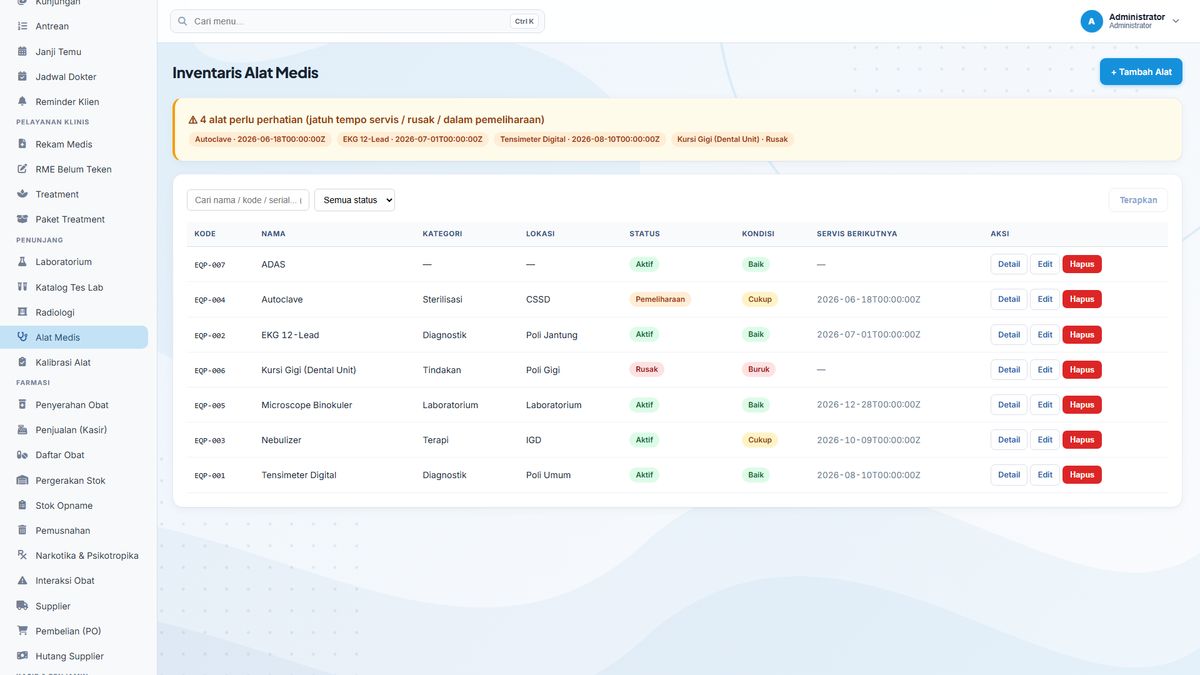
SIMRS Medical Equipment Inventory Module: Asset Registry and Maintenance
The Medical Equipment Inventory module supervises the non-medicine assets that are often tracked in spreadsheets and often lose their trail: medical equipment and healthcare devices. The module records every device as an asset with clear identity and location, then keeps its condition status and maintenance schedule so the equipment needed does not disappoint when it is used.
Asset registry and equipment identity
Every device is recorded in an asset registry: device identity, type, location, and the person responsible. With a structured registry, the facility knows exactly what equipment it owns, where it is, and in what condition. Without guessing from manual notes. The registry is also the basis for equipment need calculations and per-unit control.
Condition status and maintenance history
The condition of every device is recorded (operational, needs repair, or under maintenance) together with its maintenance history. When a device is serviced or repaired, the event is recorded in the device’s history, so the team can see maintenance patterns and assess when a device should be repaired, serviced again, or considered for replacement.
Service and calibration reminders
Medical devices have service and calibration schedules that must not be missed. The module records these schedules and reminds the team when the time comes, so the facility does not rely on memory or sticky notes. Maintained schedules help keep devices calibrated and support documentation needs during accreditation reviews.
Supports operational control per unit
Because every device is linked to its unit and location, oversight can be done per unit. Unit heads see the condition of devices in their unit, while management sees a facility-wide summary. The same data is used by procurement when planning new purchases and by the maintenance team when scheduling repairs.
Who uses this module
Inventory and general affairs staff record and update assets; the maintenance team schedules service and calibration; unit heads monitor devices in their unit; and management reads asset condition summaries. Access is role-based.
One data set, one flow
Medical equipment inventory works with other modules on the same asset data. Devices recorded here can be linked to the unit and responsible person managed in the HR module; the need for new equipment or spare parts flows into the procurement flow; and maintenance history feeds the facility’s decision on whether to repair or replace a device. Because device history is stored since registration, the question “when was this device last serviced?” can be answered without hunting through files.
Getting started with this module
The module can start from the facility’s core needs first, then grow in phases. In line with HealthCore’s implementation principles. In the early phase, the facility team prepares the asset registry and per-unit responsibilities, defines condition recording patterns, then trains inventory and maintenance staff on that flow. Role-based training, go-live support, and data migration are quoted separately from subscription pricing, so the facility starts from the highest-impact flow without changing every process at once.